
How to Become Financially Independent in Nigeria, Regardless of the Economic Condition
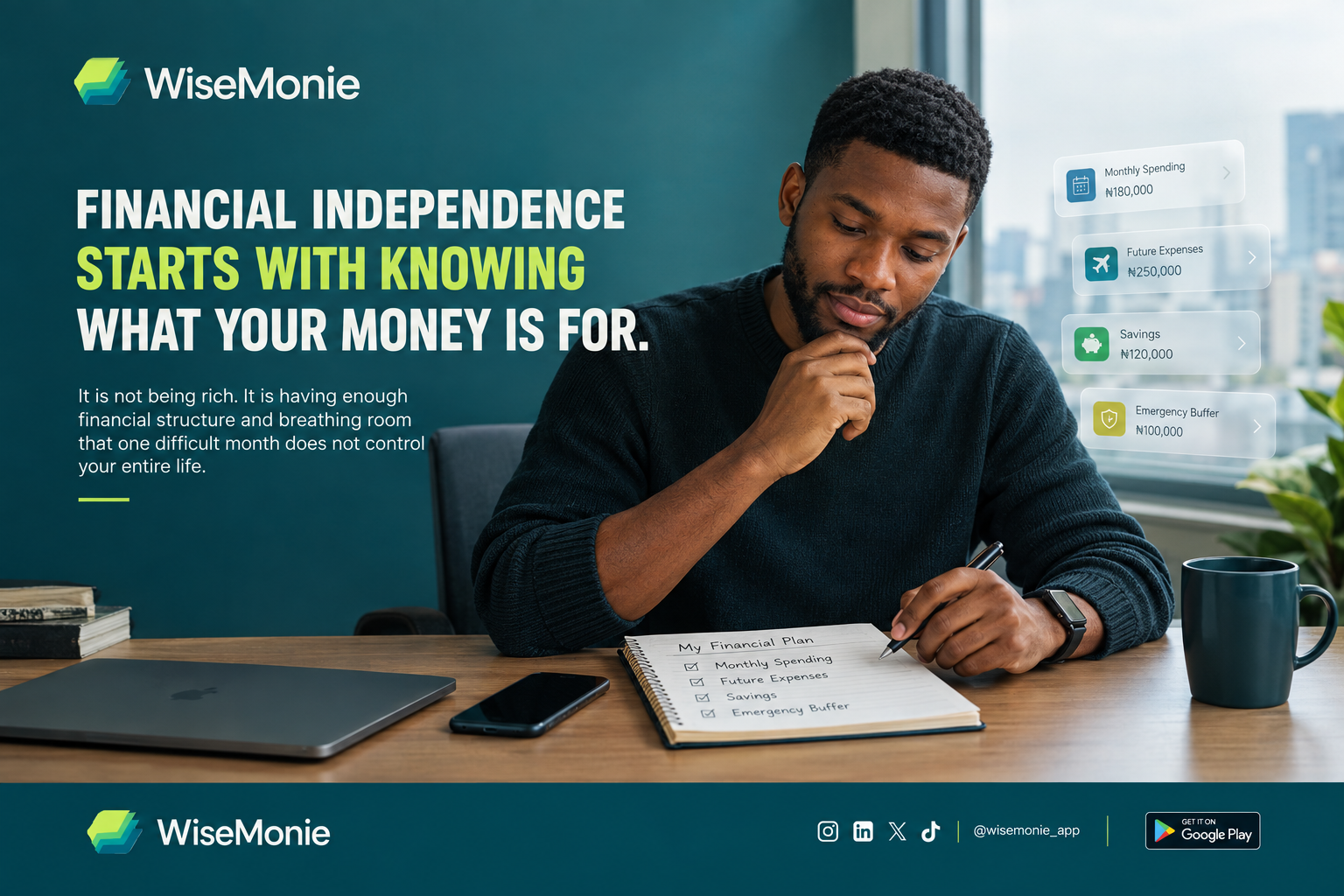
How to Become Financially Independent in Nigeria, Regardless of the Economic Condition
Financial independence sounds simple until you try to achieve it in Nigeria.
Prices change.
Transport costs change.
Food costs change.
Someone at home may need your help.
Your rent will eventually be due again.
Your income may stay the same while your expenses quietly increase.
And just when you think you have finally figured things out, something happens that wasn't in the plan.
So when someone says:
"Just budget better."
You may want to ask:
"Budget better with what?"
That is a fair question.
Financial independence does not mean pretending economic conditions don't matter.
It means building a financial system that gives you more room to make decisions even when conditions are difficult.
Nigeria's headline inflation rate was 15.39% in August 2026, while food inflation stood at 19.57%, according to the National Bureau of Statistics. At the same time, the World Bank notes that household incomes have not fully recovered despite improvements in some macroeconomic indicators. :contentReference[oaicite:1]{index=1}
So the goal isn't:
"How do I become rich enough that nothing affects me?"
The more realistic question is:
"How do I build a financial life that can absorb more of what happens around me?"
That is where financial independence starts.
What does financial independence actually mean?
Financial independence does not necessarily mean retiring at 35.
It doesn't mean owning a mansion.
It doesn't mean having millions sitting in your account.
And it certainly doesn't mean never needing anyone again.
For most Nigerians, financial independence is better understood as having financial room to make decisions without being forced into desperate choices every time something happens.
It means:
- You can handle your normal monthly expenses.
- You don't need to borrow every time you reach the end of the month.
- You have money set aside for expenses you know are coming.
- An unexpected expense doesn't immediately destroy your entire month.
- You have skills that can generate income beyond one source.
- You know what you can actually afford before you spend.
- You can support people you care about without constantly putting yourself in financial trouble.
- Your financial progress isn't completely dependent on your next salary.
That is a much more useful definition of independence.
Step 1: Know your financial reality before trying to improve it
You cannot become financially independent from a financial situation you don't understand.
Start with four numbers.
1. How much comes in?
Include your salary, freelance income, business income and other reasonably predictable income.
Don't use your best month.
Use a realistic number.
If your income changes every month, work with a conservative average.
2. How much must go out?
These are expenses you cannot casually remove.
Rent.
Transport.
Food.
Utilities.
School-related responsibilities.
Debt repayments.
Family commitments.
Other necessary expenses.
3. How much are you currently borrowing?
This one matters.
If you regularly borrow ₦10,000, ₦20,000 or ₦50,000 before the next salary, don't hide that number from yourself.
Borrowing is part of your current financial reality.
4. How much do you actually have available?
Your bank balance is not necessarily your available money.
If you have ₦200,000 in your account but ₦120,000 is already committed, you do not have ₦200,000 available for whatever catches your attention.
You have a ₦200,000 balance.
Those are different things.
Step 2: Stop making your salary one big pile of money
One of the easiest ways to lose control of your money is to treat your entire salary as one amount.
Salary enters.
Everything comes out of the same pool.
You spend.
You transfer.
You help someone.
You buy something.
You save what remains.
Then you check your balance and wonder where everything went.
Instead, give your money a purpose before you start spending it.
For example, imagine someone earns ₦300,000.
Instead of thinking:
"I have ₦300,000."
Think:
"This ₦300,000 already has things it needs to do."
Some will handle commitments.
Some will cover everyday spending.
Some will be protected for future expenses.
Some may go toward savings or goals.
Some can be available for helping family.
Some can be available for enjoyment.
The exact amounts will be different for everyone.
The important part is that you decide what the money is for before everything else starts asking for it.
Step 3: Build a buffer before chasing financial freedom
You don't need to jump straight to investing.
First, build breathing room.
Why?
Because without a buffer, every unexpected expense becomes a financial emergency.
Imagine your monthly financial plan is working perfectly.
Then something unexpected happens.
You need ₦30,000.
If you have no buffer, you now have three choices:
- Borrow.
- Take money from another purpose.
- Ignore the problem and hope it disappears.
None of these gives you much room.
But if you have a buffer, the same problem may simply become:
"This is what my buffer is for."
Your first financial milestone should therefore not necessarily be:
"I want ₦10 million."
It could be:
"I want enough money set aside that one unexpected expense doesn't immediately force me to borrow."
Then build from there.
Step 4: Stop using your next salary to rescue your current salary
This is one of the clearest signs that your current financial system isn't working.
You spend more than you planned.
Then you tell yourself:
"Next salary will sort it."
Next salary arrives.
You use part of it to fix the previous month.
Then another expense happens.
You spend again.
Then you wait for the next salary.
Now every salary is arriving with unfinished business from the previous one.
You never really get a fresh start.
Financial independence requires breaking that cycle.
Before you spend money, ask:
"Am I spending this month's money or borrowing from next month's?"
If the answer is next month's money, pause.
Step 5: Create a "safe to spend" number
This is one of the most useful habits you can develop.
Don't just ask:
"How much is in my account?"
Ask:
"How much can I actually spend?"
For example:
You have ₦250,000.
But after accounting for money already committed, future expenses, savings and your buffer, you determine that only ₦45,000 is genuinely available for flexible spending.
Your financial reality isn't:
"I have ₦250,000."
It is:
"I have ₦45,000 that I can freely spend."
That changes the decisions you make.
Suddenly, that ₦15,000 purchase looks different.
You aren't comparing ₦15,000 with ₦250,000 anymore.
You're comparing it with ₦45,000.
Step 6: Learn to earn beyond one income source
Budgeting can help you manage money.
But there is a limit to how much you can optimise a fixed income.
If your necessary expenses are consistently higher than your income, you don't have a budgeting problem alone.
You have an income problem too.
That means financial independence should include building your earning capacity.
This doesn't necessarily mean starting five businesses.
It could mean:
- developing a valuable professional skill
- taking freelance work
- building a small business
- consulting
- learning a technical skill
- creating a product
- improving your career prospects
- finding ways to turn an existing skill into additional income
The important distinction is this:
Don't build additional income simply so you can increase your spending.
Build additional income so you can create more breathing room.
If your income increases by ₦100,000 and your lifestyle immediately increases by ₦100,000, you may feel richer without actually becoming financially stronger.
Step 7: Don't let every increase in income become an increase in lifestyle
This is where lifestyle creep enters.
You earn ₦200,000.
You struggle.
Your income increases to ₦300,000.
Your spending increases too.
Then you earn ₦400,000.
Your commitments increase again.
Eventually you are earning twice what you used to earn but still saying:
"Money is not enough."
Sometimes higher income is genuinely needed.
But higher income alone does not guarantee financial independence.
The question is:
What happens to the extra money?
If every increase immediately disappears into a bigger lifestyle, your financial position may not change much.
Use part of increased income to improve your financial foundation.
Step 8: Learn to say "I can't afford that right now"
This applies especially to family and friends.
Being financially independent doesn't mean becoming selfish.
But if every request automatically comes out of your money, your own financial plan will always be vulnerable.
Someone needs ₦20,000.
You send it.
Someone else needs ₦10,000.
You send it.
You have another request.
You borrow to help.
Now you're broke.
Then when salary comes, you start again.
You need a limit.
You can decide:
"This is how much I can comfortably use to support other people this month."
When that amount is gone, you don't automatically take money from rent, savings, food or your emergency buffer.
You can still care.
You just stop making every request your personal financial emergency.
Step 9: Plan for expenses that are not monthly
One of the reasons people constantly feel surprised by expenses is that they only plan for what happens this month.
But some expenses are predictable even if they don't happen every month.
Rent.
School fees.
Annual subscriptions.
Insurance.
Repairs.
Travel.
Festive periods.
Major purchases.
Family events.
The expense may be several months away.
That does not make it an emergency.
If you know it is coming, start giving it a place now.
For example:
If you need ₦240,000 for an expense in 12 months, the problem is very different if you start setting money aside monthly than if you wait until the expense arrives.
A future expense becomes less frightening when you stop treating it like a future surprise.
Step 10: Protect yourself from impulse spending
Financial independence is difficult when every moment of excitement becomes a financial decision.
You see something.
You want it.
You think:
"I deserve this."
Or:
"It's just ₦5,000."
Or:
"I'll replace it."
Then you spend.
The individual purchase may not look serious.
But repeated decisions like that can slowly consume money that had another purpose.
Before an unplanned purchase, ask:
Do I want this?
Not just:
"Can I buy this?"
What money am I taking it from?
If you don't know, that's a warning.
What changes if I spend this?
Will something else become difficult?
Financial independence doesn't mean never enjoying your money.
It means knowing which money you can enjoy without creating another problem.
Step 11: Don't confuse moving money with saving money
Moving ₦20,000 from your current account to another account can feel like progress.
But if you move it back every time you need money, you haven't really built much protection.
The same applies to constantly moving money between accounts simply to make your balance look smaller or larger.
A financial system should help you know what money is actually available and what money should stay protected.
Saving isn't only about where the money sits.
It's also about whether you can consistently leave it there for the purpose you intended.
Step 12: Invest, but don't invest money you still need
Once your basic financial foundation is becoming stronger, you can think about longer-term wealth building.
But don't let investment become another form of impulse spending.
You see an opportunity.
Everyone is talking about it.
You feel like you're missing out.
So you move money that you actually need into the investment.
Then an expense comes.
You have to sell, withdraw or borrow.
The question isn't simply:
"Is this investment good?"
The first question is:
"Is this actually spare money?"
Your emergency money should not become investment capital simply because you saw an exciting opportunity.
Understand the product, the risks, the time horizon and whether the money can genuinely stay invested.
Financial independence is not about chasing every opportunity.
It is about having enough structure to choose opportunities without putting your basic financial stability at risk.
Step 13: Build skills that increase your financial options
Money can give you options.
But skills can help you create more options.
Ask yourself:
"If my current income stopped tomorrow, what could I do?"
Not to scare yourself.
To prepare yourself.
What can you build, sell, teach, develop, repair, design, manage or solve?
The more valuable problems you can solve, the more opportunities you can potentially create.
This is especially important in an economy where job creation remains a major challenge. The World Bank says Nigeria's labour force is growing by about 3.5 million people annually while job creation remains insufficient. :contentReference[oaicite:2]{index=2}
Your financial independence strategy therefore shouldn't only be about reducing expenses.
It should also include increasing your ability to earn.
A simple financial independence framework
If all of this feels like too much, start with five things.
1. KNOW
Know how much comes in.
Know how much must go out.
Know how much you owe.
Know what is already committed.
2. PLAN
Decide what your money is for before you start spending.
3. PROTECT
Build a buffer.
Protect future expenses.
Don't make every naira available for today's spending.
4. EARN
Improve your skills.
Increase your earning capacity.
Build additional income where realistic.
5. GROW
Once your foundation is stronger, work toward long-term goals and investments that match your situation and risk tolerance.
That's the journey.
Not:
Earn → spend → borrow → repeat.
But:
Earn → plan → protect → spend → build → grow.
What financial independence could look like in real life
Imagine two people both earn ₦300,000.
Person A receives ₦300,000 and sees:
₦300,000 available.
They spend, transfer, help people and save whatever remains.
Person B receives the same ₦300,000 but immediately gives the money different purposes.
Some is committed.
Some is protected.
Some is for everyday spending.
Some is for future expenses.
Some is for helping family.
Some is available for enjoyment.
Some goes toward building their financial foundation.
Their income is exactly the same.
The economy is exactly the same.
Prices are exactly the same.
But their relationship with the money is different.
That's important.
Financial independence does not begin when you have a huge amount of money.
It begins when you stop treating every naira you receive as equally available.
And this is where WiseMonie comes in
A lot of financial advice tells you to make a budget.
But creating a budget is only part of the problem.
The harder part is living according to it.
You plan ₦20,000 for something.
Then money enters one account.
Everything looks available.
You spend from it.
You move money around.
You borrow from one plan to fund another.
Then your original budget no longer reflects reality.
WiseMonie is built around a different idea:
Plan your money, give it purpose, and spend directly from what you have planned.
Instead of simply asking:
"How much money do I have?"
you should be able to ask:
"How much can I actually spend?"
That distinction matters.
Because financial independence isn't only about how much you earn.
It is also about how much of your money you can protect, how intentionally you spend it, and how much financial breathing room you are building over time.
You don't need perfect economic conditions to start
Nigeria's economy will change.
Prices will change.
Your income may change.
Your responsibilities may change.
Some months will be easier than others.
The goal isn't to build a financial plan that works only when everything goes perfectly.
Build one that can survive real life.
A plan that leaves some room.
A plan that knows what money is committed.
A plan that protects future expenses.
A plan that doesn't depend on borrowing before the next salary.
A plan that allows you to help people without destroying your own finances.
A plan that makes room for enjoyment.
A plan that gives additional income somewhere to go.
And a plan that gets stronger as your income grows.
Financial independence is not about waiting for Nigeria to become an easier place to live.
It is about building enough financial structure, earning capacity and breathing room that you can make better decisions even when things are difficult.
You may not control the economy.
You may not control prices.
You may not control every emergency.
But you can start controlling what happens to the money that comes into your hands.
Know what you have.
Know what it is for.
Protect what matters.
Spend what is actually available.
Build your ability to earn.
And give yourself enough room that one bad month doesn't become a financial crisis.
That's where financial independence starts.